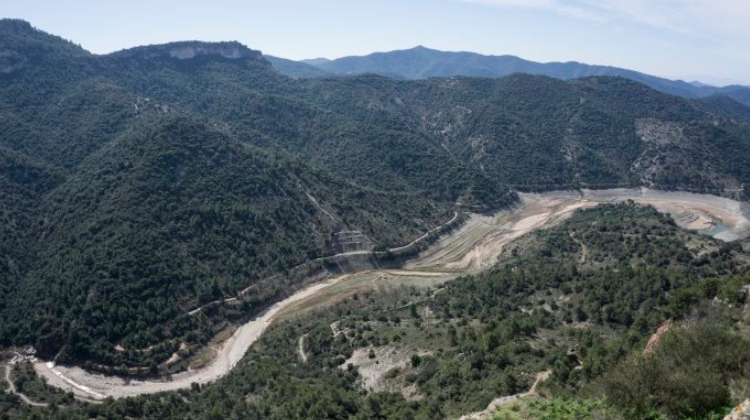
Area of Natural Interest of the Prades Mountains
The Prades Mountains are a first-rate natural space in Catalonia that meets the basic requirements of diversity, representativeness and uniqueness, and form part of the Catalan Mediterranean system. The area constitutes a perfectly identifiable geographical unit between the districts of Alt and Baix Camp, Conca de Barberà and Priorat.
It is a biogeographically exceptional space that incorporates specially protected natural spaces within it, such as the Titllar and Trinitat partial nature reserves.
The coexistence of fully Mediterranean landscapes with others from Central Europe, even including boreal landscapes, makes it a very interesting space from a biogeographical point of view. The changes in slopes, the altitudinal gradient, the different substrates, anthropogenic action, etc. allow the installation of very diverse biocenoses, such as the Pyrenean oak groves, unique in Catalonia, which are spread over the space forming a complex mosaic. On the other hand, the existence of palaeontological sites of great scientific value, declared World Heritage sites by UNESCO in 1992, must be considered.
As a whole, it is one of the basic natural spaces of special interest for Catalonia, and preserves unique scientific, landscape and socio-cultural values in the country.
A dedicated team with environmental informants will ensure responsible and orderly access to the gorges and river areas most frequented during the summer. In this way, we aim to guarantee the right both to recreation and the protection of the environment.
Information
Impacts
In this space, erosive processes and the degradation of natural systems take place due to the road traffic and the opening of tracks in places with steep slopes.
In some areas, over-visiting also causes excessive pressure on the environment, especially in places such as the Brugent River, Siurana, La Mussara, etc.
Existing extractive activities also entail a substantial alteration of the functioning of natural systems.
Finally, it should be noted that the introduction of species (American crab, Florida turtle, etc.) and the proliferation of feral domestic animals (cats, dogs, etc.) cause damage to native species and, in general, to ecosystems
Natural vulnerability
The fact that there are plant communities typical of other biogeographical zones makes this space particularly sensitive to climate change.
In this space, erosive processes and the degradation of natural systems take place due to the road traffic and the opening of tracks in places with steep slopes.
In some areas, over-visiting also causes excessive pressure on the environment, especially in places such as the Brugent River, Siurana, La Mussara, etc.
Existing extractive activities also entail a substantial alteration of the functioning of natural systems.
Finally, it should be noted that the introduction of species (American crab, Florida turtle, etc.) and the proliferation of feral domestic animals (cats, dogs, etc.) cause damage to native species and, in general, to ecosystems
Natural vulnerability
The fact that there are plant communities typical of other biogeographical zones makes this space particularly sensitive to climate change.
Reserva
Respecta'l
Accesibilitat
Agenda
Aquest lloc web utilitza galetes (cookies) pròpies per millorar l’experiència de navegació i oferir continguts d’interès. Per continuar la navegació cal acceptar la nostra política de galetes.